Las Vegas
Handyman Co.
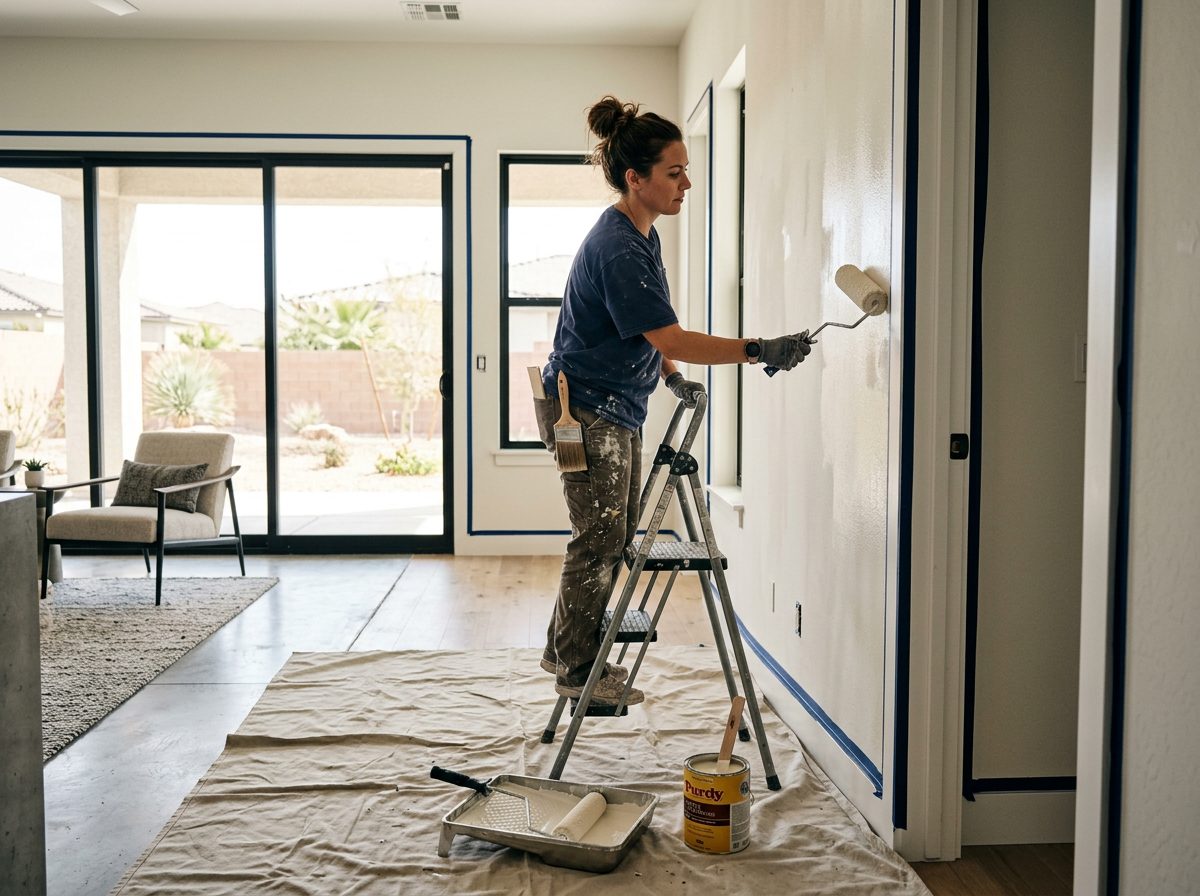
Freshly painted living room in a Las Vegas home with light neutral walls, crisp white trim and a smooth ceiling after interior painting

Interior paintingin Las Vegas.

Rooms, ceilings, trim and doors. Walls patched and prepped first, clean lines, furniture protected.

Get your price in 60 seconds

Pick a job. We text you a flat quote.

What do you need?
5.0 from 67 reviewsYour number stays with us
5.0 ★67 Google reviews
5.0 ★Top Pro on Thumbtack
FaveRecommended on Nextdoor
InsuredEvery job covered

What's included

  • Walls and ceilings
  • Trim and doors
  • Drywall prep
  • Accent walls

Interior painting in Las Vegas starts with prep

Good interior painting in Las Vegas is mostly prep. Nail pops, door-knob holes, settlement cracks and old patches all show through fresh paint, so we fix them first, match the wall texture and prime the repairs before any color goes on.

Many Las Vegas homes have a sprayed texture on the walls, commonly knockdown or orange peel. A patch left smooth on a textured wall stands out under any light, especially the low afternoon sun through west-facing windows, so the texture is matched before painting.

Then comes protection. Floors are covered, furniture is moved to the center of the room and wrapped, and switch plates and outlet covers come off rather than getting painted around. Trim and doors are brushed and rolled or sprayed, depending on the finish you want and how much masking the room allows.

In 1970s to 1990s homes in Paradise, Spring Valley and older Henderson, expect more patching: settlement cracks at door corners, old anchor holes and earlier touch-ups in a slightly different color. Newer builds usually need less repair, but builder-grade flat paint often scuffs easily and benefits from a more washable finish.

What goes into an interior painting quote

Square footage is only part of it. Ceiling height matters a lot here, since many homes have vaulted ceilings or two-story entries and stairwells that need tall ladders or scaffolding. The number of colors matters too: every accent wall or color change at a corner adds cutting in and time.

Condition drives the rest. Walls with lots of repairs, smoke or water stains, or glossy old paint need spot priming or a full coat of primer. Going from a dark color to a light one usually takes an extra coat. Trim and doors take more time per square foot than walls, and six-panel doors take longer than flat ones.

Paint grade matters as well. Higher-quality paint covers better and holds up to scrubbing, which is worth it in hallways, kids' rooms and kitchens. The written flat quote lists the rooms, surfaces, number of coats and the paint line, so you know exactly what you are paying for.

Small jobs, like a single accent wall or touch-ups after a repair, can often be quoted from photos. Whole rooms and whole houses are measured in person.

Painting in a dry desert climate

Low humidity and heat make paint dry fast in Las Vegas, especially in summer. That sounds helpful, but it is hard on the finish: if a wall is rolled too slowly, the edges dry before the next pass and leave lap marks. We work one full wall at a time with a wet edge, and keeping the air conditioning on helps the paint level out.

Dust is the other local factor. Fine desert dust settles on everything, and it clings to walls and trim near vents and doors. Walls get wiped down before painting so the new coat bonds to the surface, not to a film of dust.

Colors look different in bright desert daylight than under store lighting, so test a sample on the actual wall and check it in the morning and evening before committing. North-facing rooms read cooler and west-facing rooms warmer, and the same gray can look like two colors in one house.

Ceilings, popcorn and the order of work

Ceilings are painted before walls, so any spatter lands on surfaces that are still to be painted. If you are thinking about removing a popcorn ceiling, do it before the walls are painted, since scraping is messy. In older homes, popcorn texture should be tested for asbestos before anyone disturbs it.

Water stains on a ceiling, for example from an old roof leak or an AC drain line, need a stain-blocking primer or they bleed through new paint. Make sure the leak is fixed first. At the end of the job, covers go back on, furniture returns to its place, and we clean up before we leave.

Occupied homes are painted room by room, so you keep using most of the house during the job. Vacant homes and move-ins go faster, since there is no furniture to move and whole floors can be masked at once.

Interior painting questions.

Does the family need to leave the house while rooms are painted?

No. Most interior painting is done with water-based paint, which has far less odor than older oil paints, and we work room by room so the rest of the house stays usable. If someone in the home is sensitive to smells, low-VOC and zero-VOC paint lines are available and can be named in the quote.

Can an existing wall color be matched for a partial repaint?

Often, if the original paint can or color name is available. Without it, a chip can be scanned and matched, but faded walls rarely blend perfectly with fresh paint, even in the same color. Painting the full wall from corner to corner usually gives a better result than spot touch-ups in the middle of a wall.

What sheen works best on textured Las Vegas walls?

Eggshell is a common middle ground: it hides texture flaws better than satin or semi-gloss and still wipes clean. Flat or matte works well on ceilings and in low-traffic rooms. Higher sheens make knockdown and orange peel texture more visible, especially where sunlight hits the wall at a low angle.

Tell us
what's broken.