Las Vegas
Handyman Co.
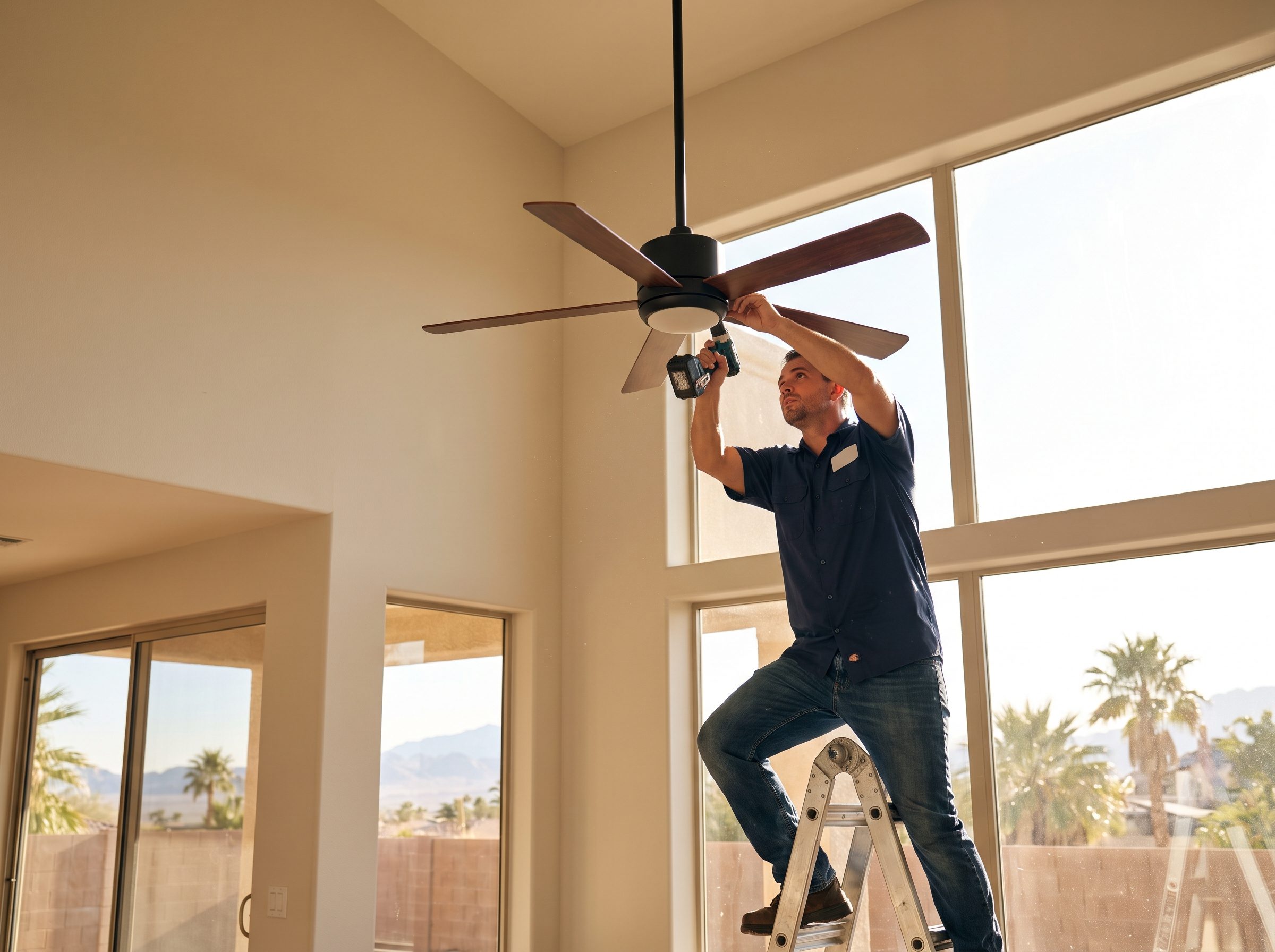
Ceiling fan with wood blades installed on a vaulted ceiling in a bright Las Vegas living room

Ceiling fan installationin Las Vegas.

New fans and fan swaps on flat and vaulted ceilings, balanced and quiet, with remotes and wall controls.

Get your price in 60 seconds

Pick a job. We text you a flat quote.

What do you need?
5.0 from 67 reviewsYour number stays with us
5.0 ★67 Google reviews
5.0 ★Top Pro on Thumbtack
FaveRecommended on Nextdoor
InsuredEvery job covered

What's included

  • Fan replacement
  • New fan boxes
  • Vaulted ceiling downrods
  • Remote and wall controls

Ceiling fan installation in Las Vegas: replacing a fan or a light

Most ceiling fan installation in Las Vegas is one of two jobs: swapping an old fan for a new one, or replacing a light fixture with a fan. Both look simple from the floor. The difference is what sits above the ceiling, and that decides how long the job takes.

A fan weighs more than a light and it moves, so it has to hang from an electrical box listed for fan support, anchored to a joist or a brace across the ceiling framing. Many light boxes are not rated for that. When we find one, we replace it with a fan-rated box before the new fan goes up.

Single-story homes usually have attic space above the ceiling, which makes a new box or brace straightforward. On the first floor of a two-story house there is finished floor above, so adding a fan where no box exists means working through the ceiling and patching afterward. We look at this before quoting so the price reflects the real job.

Vaulted ceilings, downrods and fan height

If your living room or bedroom has a vaulted or sloped ceiling, the fan needs a canopy that can angle or a sloped-ceiling adapter. It also needs a downrod long enough that the blade tips clear the slope of the ceiling.

Height matters for safety and for airflow. Blades need to sit at least 7 feet above the floor, and most fans move air best with the blades about 8 to 9 feet up. On a tall ceiling that means a longer downrod, so the breeze reaches you instead of stirring air near the top of the room.

Tall ceilings also change how the job is done. Anything over the reach of a standard ladder, like a two-story great room or entry, needs a taller ladder or scaffold, and we plan for that in the quote. Tell us the ceiling height when you send photos; a rough guess is fine.

Fans in the desert heat: sizing, direction and controls

With summer highs above 110°F, ceiling fans in Las Vegas run for months at a stretch. A fan cools people, not the room, so it lets you feel comfortable with the thermostat set a little higher. That only works if the fan is sized for the room: a small fan in a large great room just spins without moving much air.

In summer, most fans should spin counterclockwise when you look up at them, which pushes air down onto the room. Covered patios need a damp-rated or wet-rated fan, not an indoor model. Out there the fan faces heat, dust and blowing rain from monsoon storms, and indoor fans are not built for it.

Controls are the last choice. A pull chain is the simplest. A handheld or wall-mounted remote works on most new fans without new wiring. If you want the fan and its light on separate wall switches, that can mean running an extra wire, which we check before quoting.

Desert dust settles on fan blades fast, and heavy buildup can throw off the balance over time. A wipe-down every few weeks during fan season keeps it quiet. If an older fan hums, wobbles or struggles on high, replacing it is often simpler than repairing it.

How a fan install goes, start to finish

We turn off the breaker, take down the old fixture, and check the box, the wiring and the circuit. Then we assemble the fan, hang it, connect it, and set the blades. Before we leave, we run it on every speed and balance the blades so it does not wobble or click.

The price depends on whether a box and wiring already exist, the ceiling height, and how many fans you are doing. A straight swap on an existing fan-rated box is the simplest job. New locations, new wall switches and tall ceilings add time. If the work needs a permit, we tell you up front.

For swaps, send a photo of the ceiling, the old fixture and the new fan box or model number. We reply with a written flat quote, lay down drop cloths under the ladder, and clean up the packaging and dust when we finish.

Ceiling fan installation questions.

Why does my ceiling fan wobble, and can you fix it without replacing it?

Wobble usually comes from a loose mounting bracket, a bent blade holder, blades of unequal weight, or a box that is not rated for a fan. We tighten the bracket and blade screws, check that the blades sit level, and use a balancing kit if needed. If the box itself moves, it gets replaced with a fan-rated brace box.

What size ceiling fan does a bedroom or great room need?

ENERGY STAR sizing guidance puts a 36 to 42 inch fan in rooms up to 144 square feet, a 44 inch fan up to 225, and a 50 to 54 inch fan in rooms of 225 to 400 square feet. Open great rooms larger than that may work better with two fans. If you are buying the fan yourself, send us the room size first and we can confirm the fit.

Can you add a ceiling fan to a room that has no light or switch in the ceiling?

Often, yes. In a single-story home we can usually run wiring through the attic to a new fan-rated box and add a wall switch. On a first floor under a second story, the route is harder and may involve small ceiling openings that get patched. This is new wiring, so we check whether it needs a permit and tell you before quoting.

Tell us
what's broken.